

Today’s global economy leaves
billions of people falling short
on life’s essentials and
is overshooting multiple
planetary boundaries.
Sustainable investing
Our investment strategy focuses on redevelopment activities that promote positive environmental and social outcomes. These activities are aimed at projects that are actively transitioning towards a more sustainable business model, aligning with the goals of the Paris Agreement and other global sustainability initiatives.
Moreover, at Revive Fund Management, we undertake processes to ensure that the projects we invest in meet our stringent sustainability criteria. We carefully evaluate each investment opportunity based on their potential positive impact, the feasibility of their transition plans, and their alignment with international standards and best practices.
We are dedicated to monitoring and reporting on the environmental and social impacts of the projects in our portfolio.
We believe in promoting transparency and accountability, and we strive to provide our investors with comprehensive and accurate information regarding our investments.
Furthermore, we recognize the importance of complying with SFDR reporting requirements. As part of our commitment to transparency, we disclose information about the environmental, social, and governance (ESG) characteristics of our investments, as well as the Principle Adverse Impacts (“PAI”) that may arise from our activities.
Throughout each project an extensive series of small to large scale interventions are implemented to reach the greatest positive impact on society and environment.

Governance
At Revive Fund Management, we are committed to conducting business with strong ethical values and adhering to industry best practices. To support this, we’ve created clear corporate governance guidelines, policies, and procedures that all team members follow.
Our Board of Directors sets the overall strategy and policies, while overseeing the day-to-day operations to ensure everything runs smoothly and responsibly.
Ecological challenges
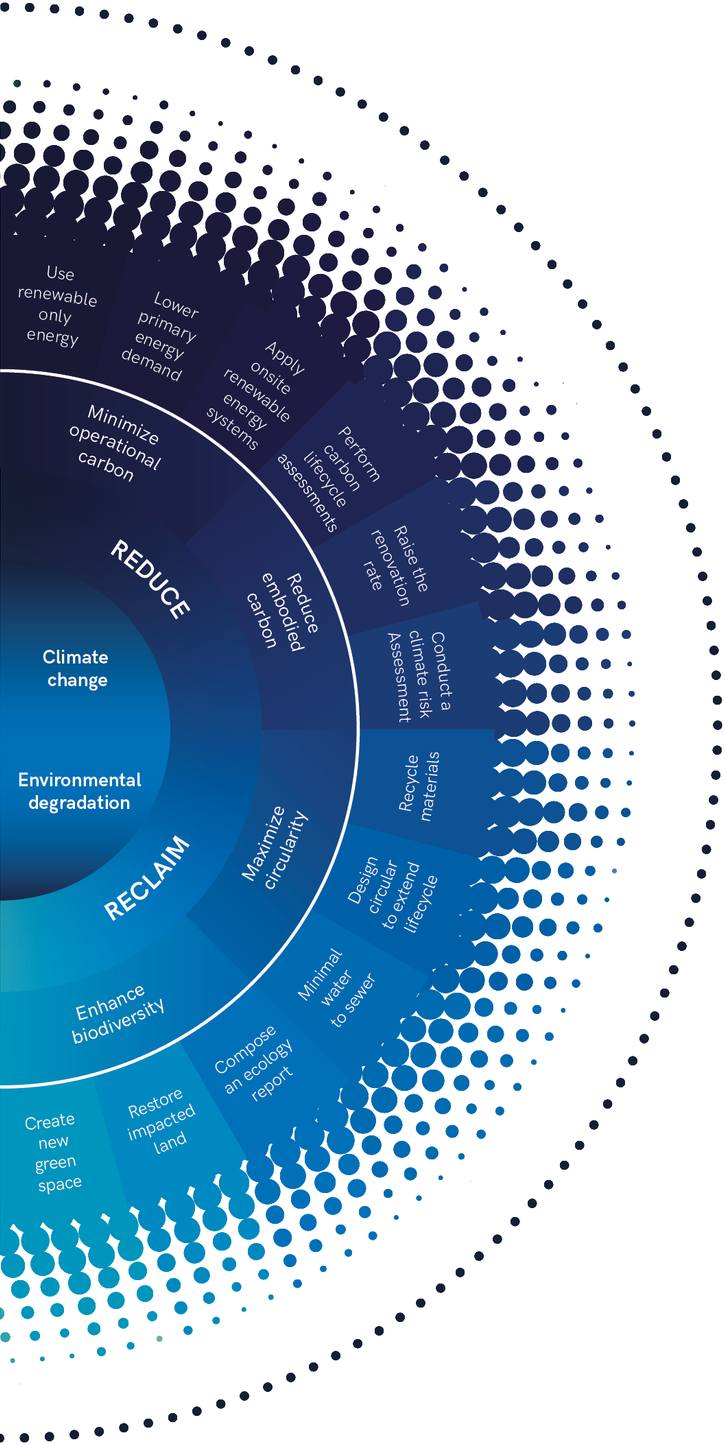
Reduce climate change
Historically, the focus has been on reducing operational carbon through measures like insulation, solar panels, electrification, eliminating gas connections, enacting legislation, ensuring clear returns on investment, and obtaining energy performance certificates. However, to meet climate targets, reducing embodied carbon is also crucial. By measuring embodied carbon, informed decisions can be made to minimise negative impact.
Reclaim habitats
Renovate, don’t demolish. Advancing circularity safeguards natural habitats, strengthens ecosystems, and preserves biodiversity. Circular practices are ensured through water reuse, sustainable materials, repurposing demolition byproducts, and land optimization. Future projects will evolve from reusing land to reusing existing buildings. Each development is tailored with a future-proof program that aligns with local needs, restoring ecological and social balance. Sustainable neighborhoods emerge that respect nature and celebrate heritage, laying the foundation for long-term community value.

Social challenges
Rebalance the lodging inequality
Lodging inequality, driven by market forces, discrimination, and segregation, limits access to quality, affordable housing. Understanding social trends like aging and family composition helps address housing needs across demographics, from vulnerable individuals to middle-class families. By balancing housing types and increasing attainability, key issues like accessibility, quality, and alternative living and working options can be tackled, supporting well-being, health, and economic stability.
Reconnect the disconnected societyRe-using of land and buildings
The goal is to reconnect a divided society. By challenging social fragmentation, this effort seeks to reduce loneliness, which negatively impacts individuals’ mental and physical wellbeing, while supporting social connectivity. Through cultivating a connected culture and designing communal infrastructure, possibilities emerge that foster social connections, increase a sense of belonging, and provide opportunities for engagement—always with respect for each individual’s space, privacy, and freedom.